Crude Grades, Gas Hubs, and Differentials: Why Your Royalty Check Does Not Match the WTI Headline
By Brad James · Founder, Pointer Petroleum LLC · Reservoir engineer
Published
Why Pricing Mechanics Matter for Mineral Owners
The headline benchmark price is rarely the realized price on a royalty check. Picture a royalty owner in Loving County, Texas, who watches the cable news ticker show oil at $80 a barrel one week and then opens the monthly statement to find a realized price closer to $61. The natural reaction is to assume an underpayment and reach for a lawyer. The actual explanation is usually more boring and more permanent: a quality discount for sour crude, a tariff for moving the barrel from a Wolfcamp pad to Midland, another tariff from Midland to a sales point at the Houston ship channel, and finally the operator's marketing fee. Same well, same lease, same fraction — but a $20 spread between the headline number on television and the price that actually feeds the royalty calculation. Understanding that spread, and how to verify it, is the difference between getting paid market and being quietly underpaid for years.
When mineral owners look at the news, they see one or two oil and gas prices: WTI at the NYMEX, Henry Hub for natural gas. When the royalty check arrives, the realized price per barrel and per Mcf is almost always different — sometimes dramatically. The difference is not normally an error, an underpayment, or post-production cost (those are separate questions). It is the basis differential between the published benchmark and the actual sales price at the wellhead or the local market.
For a Permian oil owner, the differential between WTI Cushing and the realized Midland sales price has at times been $0.50 per barrel and at other times $20 per barrel. For a Permian gas owner, the basis between Henry Hub and Waha has at times been negative $0.20 per Mcf and at other times negative $5 per Mcf — meaning the operator received less than nothing for raw gas at the wellhead. For an Appalachian gas owner, the Marcellus to Henry Hub basis can swing $1-2 per Mcf depending on pipeline capacity to Gulf markets.
Understanding the structure of these differentials — what drives them, where they are reported, and how they show up on your check — is the difference between accepting whatever the operator pays and being able to verify that the realized price reflects the local market.
Crude Oil Grades and Why They Price Differently
Crude oil is not one product — it is a spectrum of hydrocarbon mixtures with different chemistry, refined value, and transportation cost. Refiners pay more for crude that yields more high-margin product (gasoline, diesel, jet fuel) per barrel and that requires less processing.
The two physical characteristics that drive grade pricing:
Gravity (API). Higher API means lighter crude, which yields more gasoline and diesel per barrel. Light sweet crudes are typically 38-42 degrees API. Medium grades are 28-37. Heavy crudes (California, Canadian oil sands bitumen) are below 25.
Sulfur content. "Sweet" crude has less than 0.5% sulfur and is cheaper to refine. "Sour" crude is above 0.5%. Sour grades require more sulfur removal capacity and trade at a discount to sweet grades.
The most-quoted U.S. grades:
West Texas Intermediate (WTI), Cushing, Oklahoma. Light (around 40 API), sweet, the NYMEX benchmark. Most U.S. crude prices are quoted as a differential to WTI Cushing.
WTI Midland. Same chemistry as WTI Cushing, but priced at the Midland, Texas hub before pipeline transportation to Cushing or to the Gulf Coast. Reflects Permian wellhead realizations.
Louisiana Light Sweet (LLS). Light, sweet, priced at St. James, Louisiana. Tends to track WTI Houston.
Magellan East Houston (MEH) / WTI Houston. Light sweet at the Texas Gulf Coast — the export-equivalent price for U.S. light sweet, often quoted at a premium to Cushing because it is dock-loadable for international export.
West Texas Sour (WTS). Sour Permian crude, trades at a discount to WTI.
Mars and Poseidon. Medium sour offshore Gulf grades.
Bakken / Williston Sweet. Light sweet from the Bakken; pricing reflects pipeline and rail takeaway from North Dakota.
Eagle Ford. Light to very light sweet, often very light condensate (50+ API) at the western edge of the play. Higher condensate content makes the realized price more sensitive to gasoline / naphtha demand.
Niobrara / DJ Basin Sweet. Light sweet Colorado crude, priced relative to WTI with a Cushing or Guernsey, Wyoming differential.
Kern River / San Joaquin Heavy. California heavy crude (12-20 API), priced at substantial discount to WTI because of refining cost and limited California takeaway.
Mars-quality medium sour Gulf grades trade in their own market because their refining yield is different from WTI. A Texas oil owner whose check shows "WTS minus $1.50" is being paid for sour crude at the WTS posting; not all West Texas crude is WTI.
Crude Differentials and How They Hit Your Royalty
The realized price for crude at a wellhead in West Texas is approximately:
Realized = WTI Cushing − [quality adjustment] − [transport from wellhead to Cushing or MEH]
The quality adjustment captures the spread between WTI and the actual chemistry of the produced crude (sweet vs. sour, exact API). The transport adjustment captures pipeline tariffs from the wellhead to the pricing point.
For a Midland-area producer, the calculation is approximately:
Midland Wellhead Realized ≈ WTI Cushing − Midland-to-Cushing pipeline transport (which can be negative if Midland is at a premium to Cushing because of export demand from MEH).
The Midland-to-Cushing differential has had two distinct eras in recent years. Through 2018, Permian production growth ran ahead of pipeline capacity, and Midland traded at $10-20 per barrel discount to Cushing — producers accepted whatever takeaway they could get. After Cactus II, EPIC, and Gray Oak pipelines came on-line in 2019-2020, Midland moved to roughly parity with Cushing. Periodically since 2021, when Gulf export demand has outpaced Permian production, Midland has actually traded at a premium to Cushing.
For a North Dakota producer, the equivalent question is the Bakken-to-Cushing or Bakken-to-MEH transport. Bakken crude moves on Dakota Access Pipeline (Patoka) plus connecting pipelines, on Tesoro to West Coast refiners, or by rail to coastal markets. Each route has a different cost and a different end market, and the Bakken differential reflects the marginal route the operator can access.
The practical implication: two royalty owners receiving "WTI-based" royalties on similar producing wells can see materially different realized prices because their operators sell at different points in the transportation chain. The royalty calculation should reflect the operator's actual realized price, net of post-production costs allowed under the lease — and the operator should be able to document which marketing arrangement applies to your production.
Natural Gas Hubs and the Geography of Basis
Natural gas pricing is even more location-dependent than crude because gas is harder and more expensive to transport. A barrel of crude can be moved by pipeline, rail, truck, or ship. A cubic foot of gas effectively moves only by pipeline (or, after liquefaction, by LNG tanker — but liquefaction is a $3-5/MMBtu cost in itself).
The major U.S. natural gas pricing hubs:
Henry Hub (Erath, Louisiana). The NYMEX benchmark. Located at the intersection of major interstate pipelines and near major LNG export terminals. Almost all gas in the U.S. is priced as a differential ("basis") to Henry Hub.
Waha Hub (Pecos County, Texas). The Permian Basin pricing point. Persistent negative basis (Waha trades below Henry Hub) because Permian associated gas production has historically run ahead of pipeline takeaway capacity.
El Paso Permian Basin (San Juan and Permian outlets). Related to Waha but covers different pipeline systems serving the West.
Dominion South Point (West Virginia). The Marcellus / Utica regional hub, often deeply discounted to Henry Hub when Northeast pipeline capacity is full.
Leidy Hub (Pennsylvania). Another Marcellus pricing point, similar dynamics to Dominion South.
Transco Zone 6 NY. The New York City pipeline delivery point — typically a premium to Henry Hub in winter because heating demand exceeds pipeline supply.
AGT Citygate (Algonquin Gas Transmission, New England). Premium pricing in winter due to extreme New England pipeline constraints. Algonquin winter spikes have historically been 5-10x Henry Hub.
Cheyenne Hub / Opal (Wyoming) and Northwest Pipeline (Rockies / Western). Rocky Mountain gas pricing.
Malin (Oregon-California border). West Coast gas pricing, with high seasonal swings.
SoCal Border. Southern California pricing point — major spikes during California summer power demand and Aliso Canyon-related supply constraints.
Houston Ship Channel and Katy Hub (Texas Gulf). Industrial demand and LNG export pricing points; usually close to Henry Hub.
The basis differential between the producing hub and Henry Hub is what drives your gas royalty math. A Marcellus producer selling at Dominion South receives the Dominion South price, not Henry Hub. The realized price feeding your royalty check is operator-specific (each operator has its own contract mix across multiple hubs), but the geographic floor is the local hub.
The Permian Waha Story: Pipeline Constraints and Negative Pricing
The Permian Basin has produced more associated gas (gas produced incidentally with oil) than its pipelines could handle for years. Gas is an unavoidable byproduct of Permian oil drilling — every barrel of Wolfcamp or Bone Spring oil comes with several thousand cubic feet of gas — and the gas has to go somewhere. When pipeline capacity out of West Texas is full, the Waha price collapses.
The most extreme episodes have been spectacular. In April 2019 and again in October 2024, Waha gas traded at negative prices for sustained periods — meaning producers were paying buyers to take gas off their hands rather than flare or curtail oil production. Negative natural gas prices were a Permian-specific phenomenon driven by the combination of high oil-driven gas growth, full takeaway, and (in some periods) pipeline maintenance reducing capacity further.
The new pipelines being built or recently completed:
Whitewater Midstream's Matterhorn Express, in service late 2024, added 2.5 Bcf/d of capacity from Waha to the Houston Ship Channel. Initial flows materially relieved Waha prices in early 2025.
Blackcomb Pipeline, expected late 2026 / early 2027, will add another 2.5 Bcf/d from Waha to the South Texas Gulf market.
ADCC Pipeline (formerly Apex), under development, would add additional Permian-to-Gulf capacity in the late 2020s.
For royalty owners, negative Waha pricing has typically meant zero royalty on gas (most leases interpret negative wellhead gas value as zero royalty rather than as an obligation to pay the operator). What it does affect is the operator's decision whether to keep producing gas at all — periods of severe negative pricing have led to flaring, curtailment, and even shut-in of associated gas production. If the well is curtailed or shut-in for gas market reasons, oil production from the same well may also be reduced, which directly hits oil royalty.
Long-term, the new pipelines should keep Waha basis in a healthier band ($0.50-$1.50 below Henry Hub in normal markets) until Permian gas growth fills the new capacity. Industry forecasts vary, but most expect Permian gas takeaway to be roughly balanced from 2026 through 2028, then tightening again through the late 2020s.
Waha vs. Henry Hub — daily spot prices
The Waha-Henry spread widened to record negatives in early and mid-2024 as Permian gas production outran takeaway capacity.
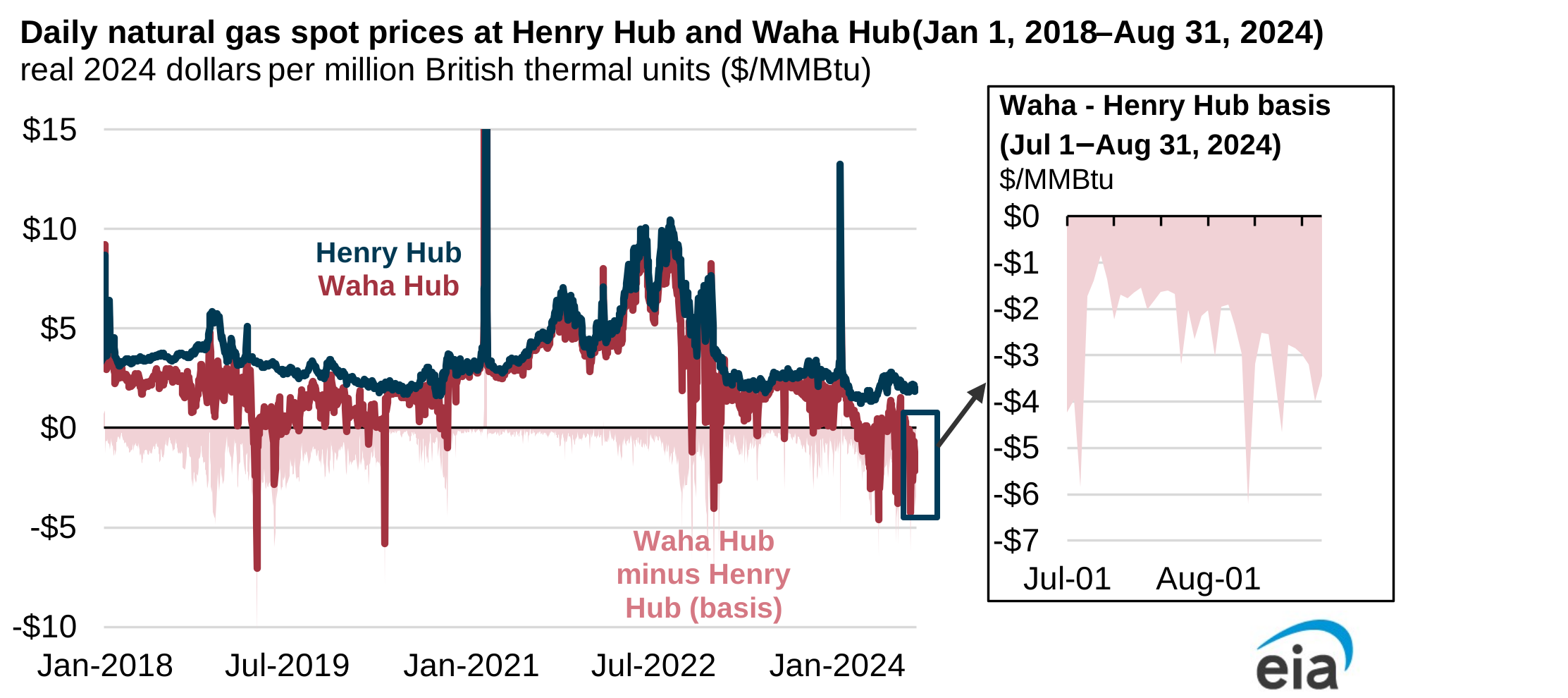
Source: U.S. Energy Information Administration, Today in Energy, “Matterhorn Express pipeline will help ease Permian natural gas takeaway constraints” (September 10, 2024). Underlying price data: Natural Gas Intelligence. Chart reproduced as a U.S. government public-domain work.
NGLs and What Is Actually in Your "Wet Gas" Royalty
Rich gas streams contain natural gas liquids (NGLs) — heavier hydrocarbons that condense out of the gas during processing. The major NGL components, in order of decreasing volatility:
Ethane (C2). The lightest NGL, used as petrochemical feedstock for ethylene production. Often "rejected" (left in the methane stream and sold as gas) when ethane prices are below the cost to extract and ship it; "recovered" (extracted as a liquid) when prices justify the processing cost.
Propane (C3). Heating fuel, petrochemical feedstock, and the major NGL by volume in most gas streams.
Iso-butane (iC4) and normal butane (nC4). Refinery blendstock and petrochemical feedstock.
Natural gasoline (C5+). The heaviest NGL fraction, used as a refinery blendstock or as a diluent for heavy crude.
NGLs are typically priced at Mont Belvieu, Texas — the Gulf Coast NGL hub where most U.S. NGL fractionation and storage capacity is located. Each NGL has its own market and its own price relative to crude oil and natural gas, and the mix of NGLs in your gas stream determines what your "wet gas" royalty is actually worth.
A representative wet gas barrel from a Delaware Basin Wolfcamp well might have a composition like 50% ethane, 25% propane, 12% iso-butane, 8% normal butane, and 5% natural gasoline. The realized price per barrel of NGLs is the weighted average of those component prices at Mont Belvieu, less fractionation and transportation costs. When ethane prices are very low, operators sometimes run "ethane rejection" — leaving ethane in the gas stream — which raises the gas BTU content and gas price slightly but reduces the liquids volume.
For royalty owners on rich gas, the NGL portion of the check is often as large as the methane portion — and it is even more sensitive to processing arrangements and post-production costs (processing fees are usually charged as a percent of liquids value, which can compound with cost-free royalty issues from the previous post in this series).
Putting It All Together: Reading Your Realized Prices
A complete picture of how your royalty was calculated requires four data points:
1) The benchmark price (WTI Cushing, Henry Hub) for the production month.
2) The realized price the operator received (which incorporates the regional hub differential and the operator's specific marketing contract).
3) The post-production costs deducted, if any (gathering, processing, transportation, treating, marketing).
4) The royalty fraction and any guaranteed minimums.
Most monthly royalty statements include realized prices per Mcf, per barrel, and per NGL barrel — verify those against published differentials for your area. Public sources for differential data include:
For crude: Argus and Platts publish daily differentials (subscription); Genscape and the Energy Information Administration (EIA) publish weekly summaries. The EIA's Weekly Petroleum Status Report and STEO have regional crude price data.
For gas: NGI Daily Gas Price Index (subscription) and the EIA Natural Gas Weekly Update both report hub prices including Waha, Dominion South, Henry Hub, and other major hubs.
For NGLs: Mont Belvieu component prices are published daily by Argus, OPIS, and other services; the EIA Petroleum Marketing Annual has historical reference data.
If your realized price is materially below the published hub price for the production month — by more than the operator's typical marketing fee plus normal contract variation — that is a flag worth investigating. A discrepancy could indicate an unfavorable marketing contract, an affiliate-sales pricing issue, or simply a hedging adjustment that is netted into the realized price. The audit clause in your lease (or the implied right of accounting under most state law) is your tool for getting the underlying numbers.
For mineral owners considering whether to hold or sell, the differential picture matters too. A producing royalty interest in an area with persistent unfavorable basis (Permian gas pre-Matterhorn, Marcellus gas during pipeline build-out periods) is worth meaningfully less than the same interest in a basin with favorable takeaway. When Pointer Minerals values a producing interest, our offer reflects the realized price history for the actual wells on the tract — not the headline benchmark — because that is the cash the interest actually generates.
Frequently Asked Questions
Why does my royalty check show a lower price than the WTI or Henry Hub headline?
The headline price is for a specific benchmark (WTI at Cushing, Henry Hub in Louisiana) — not for the wellhead where your production is sold. The realized price at your wellhead reflects: (1) the quality of the actual crude or gas produced (sweet vs. sour, BTU content, NGL yield), (2) the cost of moving the product from the wellhead to the market pricing point, and (3) the basis differential between the local hub and the benchmark. Permian gas at Waha can trade $0.50 to $5 per Mcf below Henry Hub; Permian crude at Midland has at times been $20 per barrel below WTI Cushing. The differential is normally legitimate market pricing, not an underpayment — but verifying it against published hub prices is worthwhile.
Can natural gas really sell at negative prices, and what happens to my royalty?
Yes — Permian Waha gas has traded at sustained negative prices in 2019 and again in October 2024, meaning producers were paying buyers to take gas off their hands. This happens when pipeline takeaway out of the basin is fully utilized and producers cannot legally flare or shut in the gas without curtailing oil production. For royalty owners, negative wellhead gas value typically results in zero royalty on gas (most leases interpret it as zero rather than as a payable to the operator). The bigger indirect impact is when negative gas prices force operators to curtail oil production from associated gas wells — which directly reduces your oil royalty.
Will the new Permian gas pipelines fix Waha pricing?
Partially and temporarily. WhiteWater Midstream's Matterhorn Express (in service late 2024, 2.5 Bcf/d from Waha to Houston) materially improved Waha basis in early 2025, and Blackcomb Pipeline (expected late 2026 / early 2027, another 2.5 Bcf/d) will add more relief. But Permian associated gas production continues to grow with oil drilling, and most industry forecasts expect takeaway to be roughly balanced from 2026 through 2028 before tightening again later in the decade. The pattern of "pipeline build relieves basis, gas growth fills it again" is likely to continue. Owners with significant gas exposure in the Permian should expect periodic Waha weakness even with the new infrastructure.
My Eagle Ford check is structurally different from my Bakken check at the same WTI. Why?
Several reasons. Eagle Ford crude is often condensate (50+ API) at the western edge of the play, which prices to gasoline and naphtha demand differently than 40-API Bakken sweet. Eagle Ford gas has high NGL yield and is processed at South Texas plants, while Bakken gas is processed at North Dakota plants with different downstream economics. Eagle Ford crude has shorter, lower-cost pipeline takeaway to Corpus Christi for export; Bakken crude faces longer pipeline routes to the Gulf or rail to West Coast refiners. Two royalty owners receiving "WTI-based" royalties on similar producing wells in different basins routinely see meaningful realized-price differences — almost all of it driven by these structural differences, not by errors or operator misconduct.
How do I check whether the realized prices on my royalty statement are reasonable?
Compare the per-Mcf and per-barrel realized prices on your statement to published hub prices for the production month at the relevant local hub (Waha for Permian gas, Dominion South for Marcellus gas, Midland for Permian crude, etc.). EIA publishes free weekly hub price summaries; Argus, Platts, NGI, and OPIS publish daily indices on subscription. Allow for an operator marketing fee (typically 1-3% of gross), normal contract variation, and any explicit post-production cost deductions on the statement. If your realized price is materially below the local hub for the same month — by more than the marketing fee plus normal variation — that is worth investigating, possibly via the audit clause in your lease or by retaining an oil and gas auditor.
Sources & Citations
Primary sources used in writing this article. These are not legal or tax advice — they are the public statutes, regulations, and authoritative materials the article draws from. Consult a qualified attorney or CPA before acting on any of them.
Related Posts
K-1 Reporting for Oil & Gas Working Interests Held Through LLCs and JOAs
An oil & gas working interest reported on Schedule K-1 (Form 1065) rather than Schedule E is a different reporting regime: depletion is computed at the partner level, IDC passes through with separate elections, the § 761(a) election can opt the venture out of subchapter K entirely, and self-employment tax exposure differs from a directly held WI. Unlike a mineral or royalty interest — which bears no operating costs — a working interest carries capital and operating expense responsibility, which is what drives the K-1 mechanics. This post is the practitioner workflow.
Percentage Depletion for Mineral Royalty Owners: IRC § 613A in Practice
IRC § 613A(c) preserves percentage depletion for the small-producer / royalty-owner class even after the 1975 repeal for integrated producers. For most individual mineral-royalty owners, the deduction is 15% of gross royalty income, reduces basis under § 1016(a)(2), and is subject to the 65%-of-taxable-income cap. This post is the practitioner workflow: when the deduction applies, when the limits bind, how it interacts with AMT, and what gets recaptured at sale.
Royalty Suspense and Escheat: Why Royalties Go Missing
State unclaimed-property offices hold hundreds of millions of dollars in unclaimed mineral royalties — owed to owners who moved without notifying operators, heirs who never learned they owned interests, and families who simply lost track.
Not Receiving Royalties From Production: Causes and Remedies
If a well is producing and you should be receiving royalties but aren't, there are several common causes and well-defined remedies. This guide covers title issues, suspense, statutory penalties, and what to do.
Related State Pages
Related Glossary Terms
Free, no-obligation offer in 48 hours.
Get a Free OfferKeep reading: how to sell mineral rights · what mineral rights are worth · inherited mineral rights